TOUR DE UGANDA 2026
A five-stage national road cycling property built for competitive credibility, destination storytelling, and sponsor return.
PURPOSE
Tour de Uganda 2026 is proposed as a five-stage road cycling event connecting sporting federations, tourism stakeholders, host districts, and commercial sponsors around one coherent national race identity. This note sets out a route that is technically feasible, visually distinctive, and commercially structured with stage logic, corrected distances, circuit design, delivery assumptions, and host-town sequencing.
Event Positioning & Delivery Logic
Tour de Uganda 2026 is built as a national road-race platform delivered across five connected stages. The race opens through the central gateway into the cattle corridor, moves into Mbarara for a controlled circuit stage, climbs into the western scenic corridor for the queen stage into Fort Portal, loops out to Kamwenge and back for a western wildlife-corridor transition day, and closes with a premium lake-region hospitality finale between Munyonyo and
Kajjansi. For riders, the corrected route balances one long opening road stage, one controlled urban circuit, one decisive queen stage, one out-and-back transition stage, and one sponsor-facing finale. For commercial partners, each stage is designed to reproduce a repeatable environment for branding, hospitality, filming, and regional engagement so the value of the event compounds stage by stage rather than resetting each day.
DESIGN
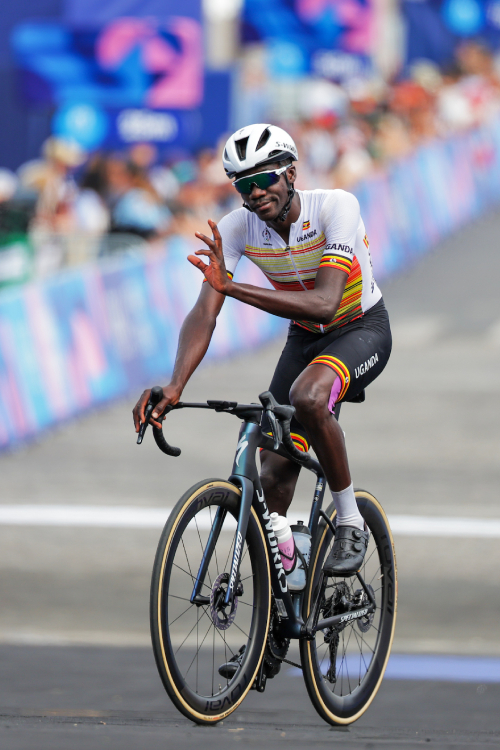
A sponsor-ready concept note anchored in real imagery: Uganda’s own riders and clubs, regional benchmark scenes
from Tour du Rwanda and the Eritrean national team, and on the closing page reference imagery from established
European Grand Tours, to show the calibre of event Uganda can grow toward.
Stage Architecture
Stage One: Mpigi – Sembabule 130 km
Opening stage; rolling and
exposed, Point-to-point road stage
Stage Two: Mbarara Circuit (6X15) 90 km
Controlled circuit; repeated
branding & crowd
concentration, Urban-commercial circuit
Stage Three: Ishaka – Fort Portal 170 km
Queen stage; scenic and
selective, Long endurance road stage
Stage Four: Fort Portal – Kamwenge – Fort Portal 130 km
Fast western transition; tea-
estate & market-town
narrative, Out-and-back transition stage
Stage Five: Munyonyo – Kajjansi 96 km
Fast closing stage; hospitality
finale, Finale circuit at Speke Resort
Stage 1 — Mpigi to Sembabule | 130 km
Stage 1 opens the race with a genuine road day from the central gateway into the cattle corridor. At 130 km, the profile is long enough to read as a real opening stage while remaining controllable for convoy management, first-day marshalling, and safety operations.
Terrain: rolling, with long open sections and wind exposure on the corridor approach.
Sporting expectation: breakaway pressure, crosswind management, and a probable reduced bunch finish if teams control the day.
Narrative value: Ankole cattle-country identity, ranchland scenery, and a western-corridor gateway feel.
Stage 2 — Mbarara Circuit | 90 km
Stage 2 is built as a controlled circuit around Mbarara - the most operationally efficient stage in the race, since timing, broadcast positioning, sponsor branding, and crowd concentration can all be repeated over multiple laps. Format: 6 laps of approximately 15 km for a practical race distance of roughly 90 km. Sporting expectation: repeated accelerations, positioning battles, intermediate sprint opportunities, and sustained pressure on team organisation. Delivery logic: compact marshal deployment, repeatable camera positions, and clearly visible sponsor inventory.
Stage 3 — Ishaka to Fort Portal | 170 km — Queen Stage
Stage 3 is the defining endurance day of Tour de Uganda 2026. At approximately 170 km, it gives the race a genuine queen-stage identity and the strongest single-day test in the event - the stage most likely to separate the general classification if ridden aggressively. Sporting expectation: attritional racing, decisive selection, fatigue management, and the best chance of meaningful GC gaps. Scenic framework: Rwenzori views, the western wildlife corridor, crater-lake country, and a refined Fort Portal finish. Host note: Fort Portal offers a credible winners' setting and proximity to Kibale activation - road imagery should evoke the corridor without compromising race operations or wildlife sensitivity.
Stage 4 — Fort Portal to Kamwenge and back to Fort Portal | 130 km
The Fort Portal–Kamwenge out-and-back is a strong transition stage, run the day after the queen stage to keep the western block self-contained around a single host town. The route stays close to the Kibale-adjacent wildlife corridor while remaining workable for timing, neutral roll-out, and sponsor exposure. Sporting expectation: a fast road day with attacking opportunities and a likely reduced sprint if teams keep the race compact. Narrative value: tea estates, market-town movement, and a visible shift deeper into the western wildlife corridor for media framing.
Stage 5 — Munyonyo to Kajjansi Finale | ~96 km
The Munyonyo–Kajjansi finale is retained because it creates a premium closing environment and a strong sponsor platform. The corridor is too short to stand alone as an elite final stage, so the design uses a lap-based finish to protect a competition-credible total distance. Sporting expectation: a controlled final day, sprint value, GC protection, and a strong podium production. Sponsor value: premium hospitality, a Lake Victoria backdrop, golf-and-leisure proximity, and a strong visual finish-line environment.